

Golden Goose Project
Mount Peyton Linear · Central Newfoundland, Canada
2,325 ha
93 mineral claims
Up to 75%
Option interest
1.3 ppm Au
over 17.3 m (2023)
4.56% Sb
best antimony intercept
Overview
A drill-ready gold-antimony system in the Beaver Brook district
Located along the Mount Peyton Linear in central Newfoundland, a regional trend of gold showings with multiple historic discoveries. The property covers approximately 2,325 hectares across 93 mineral claims, and Refined Energy holds an option agreement to earn up to a 75% interest.
2023 drilling completed 969.5 m in 8 holes, confirming near-surface gold mineralization and identifying new mineralized zones, including 1.3 ppm Au over 17.3 m. The best antimony intercept was 4.56% Sb over 1.0 m.
The Golden Goose Project hosts the Corsair, Apache, Comanche and Sabre showings. Mineralization is structurally controlled and associated with quartz-sericite-pyrite alteration carrying gold and antimony.
Explore the property
Location · Geology
01 / 02
Location & access
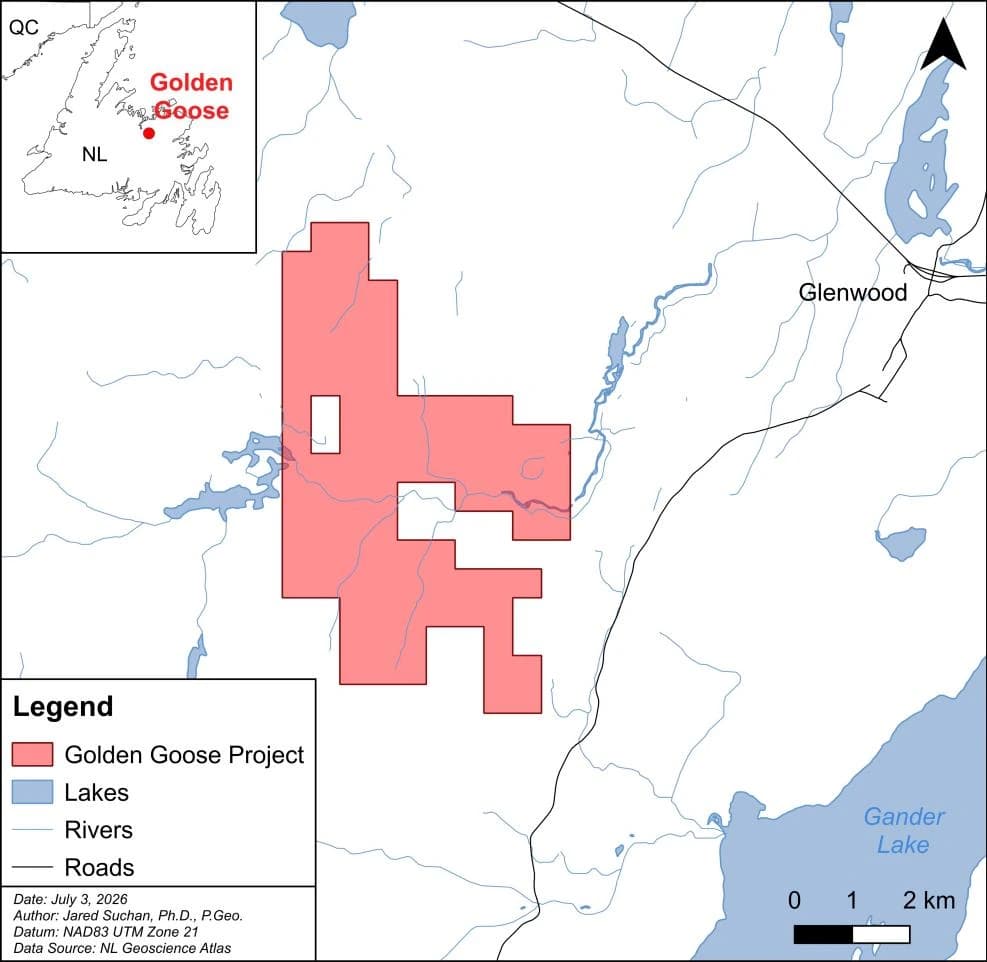
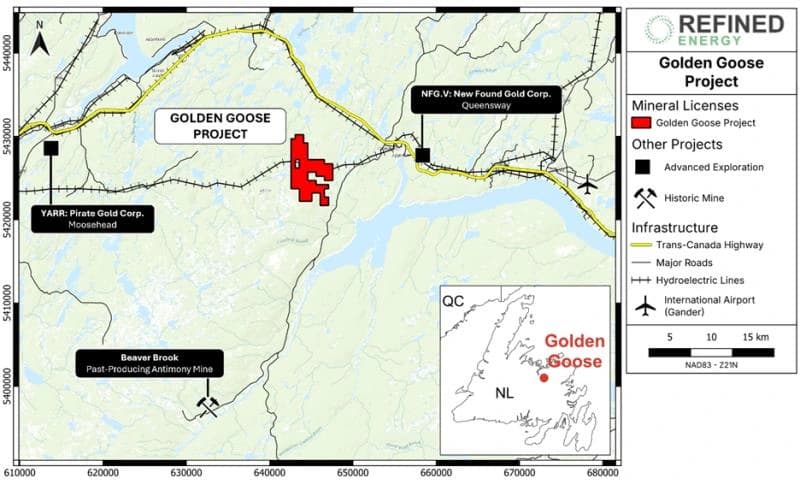
- Located approximately 30 km west of Gander and 46 km east of Grand Falls-Windsor, Newfoundland.
- Property is 5 km south of the Trans-Canada Highway and 2 km west of the Beaver Brook Resource Road.
- Access is supported by forestry roads, snowmobile trails and all-terrain vehicle trails — most areas reachable by vehicle or short walk-in.
- Terrain is low-lying, forested and locally swampy, with sparse outcrop and 1–5 m of glacial till cover.
02 / 02
Geology & mineralization
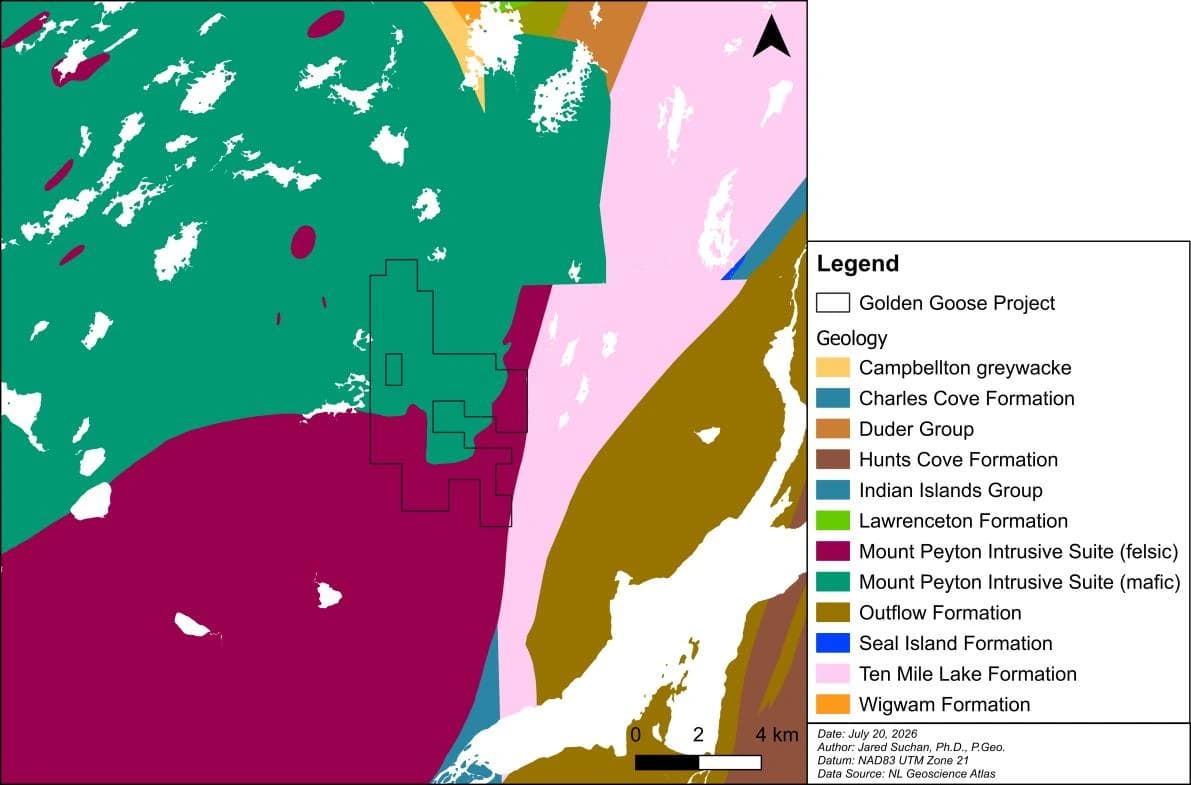
- Mineralization is structurally controlled and hosted mainly in altered diorite, associated with northeast-striking fault systems.
- Key mineralization style: quartz-sericite-pyrite alteration with arsenopyrite and stibnite, carrying gold, antimony, arsenic and locally silver.
- Corsair and Hurricane trends are northeast-striking gold-antimony-arsenic systems associated with induced polarization chargeability anomalies.
- Multiple mineralized zones identified by 2023 drilling along the Corsair and Hurricane trends.
Exploration history
Four decades of work
- 1988Discovery
Government lake-sediment sampling identified anomalous gold values in the Mount Peyton area, prompting follow-up prospecting along the Salmon River that led to the discovery of gold-mineralized boulders and the Hurricane, Corsair, Apache, Comanche and Sabre showings.
- 1989Noranda
Noranda completed line cutting, soil and silt sampling, mapping, magnetic/VLF/IP surveys and test pitting, defining the Hurricane and Corsair Au-Ag-As-Sb trends and associated chargeability anomalies.
- 1990Noranda · 14 holes
Noranda expanded the grid, collected additional soil samples, completed further IP surveying, identified the Peyton Trend and drilled 14 holes testing coincident geochemical and geophysical targets, with several gold-bearing altered zones intersected.
- 2007Paragon · 2 holes
Paragon completed prospecting, rock sampling and two diamond drill holes that extended Hurricane Trend mineralization to depth and confirmed additional sericite-silica-pyrite-arsenopyrite alteration.
- 2022Etruscus · Geophysics
Etruscus completed approximately 33.5 line-km of line cutting, 30.3 line-km of IP surveying, 40 line-km of walking magnetometer surveying and 3D geophysical inversions to refine chargeability and resistivity targets associated with potential gold-bearing structures.
- 2023Etruscus · 969.5 m · 8 holes
Etruscus completed 969.5 m of diamond drilling in 8 holes as step-outs to historic mineralization, confirming extensions of known gold zones and identifying new gold-antimony mineralization associated with pyrite/stibnite, intense sericite alteration and quartz alteration.
- NextPlanned
A focused 1,500 metre drill program in 10 to 12 holes targeting the Corsair and Hurricane trends and other untested geophysical targets.
Next step
Planned drill program
- 1,500 m
- Focused program
- 10–12
- Drill holes
- Compile and rank targets by integrating the 2021 Au-As-Sb soil/rock anomalies, 2022 IP/magnetic inversions and 2023 drill results into a single target model.
- Prioritize follow-up drilling on the Corsair and Hurricane trends, which the 2023 drilling confirmed as the highest-priority mineralized trends with significant untested gaps.
- Follow up MP23-08 and other weakly tested chargeability anomalies, as MP23-08 may represent a new mineralized zone or trend outside the main historic corridors.
- Plan a focused 1,500 metre drill program in 10 to 12 holes to test continuity, geometry and grade repeatability along northeast-striking mineralized trends and other untested geophysical targets.
Maps
Property maps
The scientific and technical information on this page relating to the Golden Goose Project has been reviewed and approved by Dr. Jared Suchan, P.Geo., Vice President, Exploration of the Company and a Qualified Person as defined by National Instrument 43-101.
Information regarding the neighbouring Beaver Brook antimony mine is taken from public disclosure of that property's owner or operator. The Company has not had a qualified person verify this information, and it is not necessarily indicative of the mineralization present on the Golden Goose Project.